📋 Table of Contents
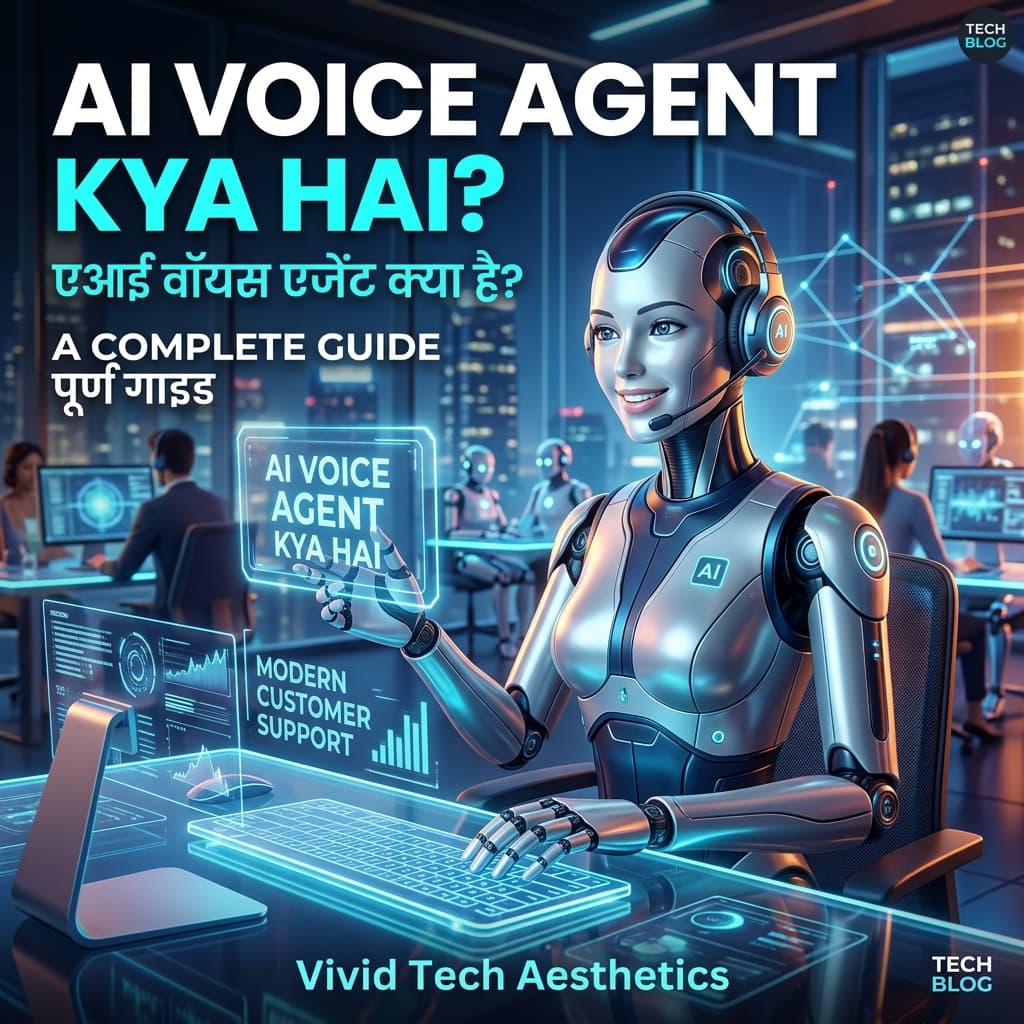
AI Voice Agent Kya Hai? The Complete Guide for 2025
In the rapidly evolving landscape of business automation, one question is echoing across industries: "AI Voice Agent Kya Hai?" (What is an AI Voice Agent?). If you've recently called a customer service line and had a seamless, human-like conversation with a machine, you've likely interacted with one. This comprehensive guide will dive deep into what AI Voice Agents are, how they work, and why they are becoming indispensable for businesses worldwide.
AI Voice Agent Kya Hai? (In Simple Hinglish)
Aaj ke digital daur mein, AI Voice Agent ek aisi artificial intelligence technology hai jo insaano ki tarah aawaz (voice) mein baat kar sakti hai. Jab aap kisi customer care number par call karte hain aur ek 'computer' aapse bilkul natural tarike se baat karta hai, aapki problem samajhta hai aur uska solution deta hai—wahi AI voice agent hai.
Pehle ke zamaane mein IVR (Interactive Voice Response) system hote the, jisme aapko "1 dabayein, 2 dabayein" sunna padta tha. Lekin AI Voice Agents usse bahut aage nikal chuke hain. Ye Natural Language Processing (NLP) aur Machine Learning (ML) ka use karte hain taaki wo aapke bole gaye shabdon aur unke piche ke emotion dono ko samajh sakein. Simple shabdon mein, ye ek smart virtual assistant hai jo aapke business ke liye 24/7 call utha sakta hai aur customers se baat kar sakta hai, bina thake aur bina kisi galti ke.
The Evolution from IVR to Conversational AI
To truly understand the magnitude of AI Voice Agents, we must look at their evolution. Traditional Interactive Voice Response (IVR) systems were rigid, rule-based trees that frustrated callers more often than they helped. They relied on DTMF (Dual-Tone Multi-Frequency) tones—pressing numbers on a keypad—and strict keyword recognition.
Enter Conversational AI. Modern AI Voice Agents represent a paradigm shift. They do not force the user into a predefined path. Instead, they understand open-ended questions, contextual nuances, and even sentiment. They leverage sophisticated Large Language Models (LLMs) combined with Text-to-Speech (TTS) and Speech-to-Text (STT) technologies to facilitate fluid, dynamic conversations.
How Does an AI Voice Agent Work?
The magic behind an AI Voice Agent is a symphony of advanced technologies working together in milliseconds. Here is the step-by-step process:
- Automatic Speech Recognition (ASR): When a user speaks, the ASR engine captures the audio signal and converts the spoken words into written text. This happens in real-time, handling various accents, dialects, and background noises.
- Natural Language Processing & Understanding (NLP/NLU): The text is then analyzed by the NLU engine. This is the "brain" of the agent. It determines the user's intent (what they want to do) and extracts relevant entities (names, dates, account numbers).
- Dialog Management: Based on the understood intent, the Dialog Manager decides the next best action. Should it fetch data from an API? Should it ask a clarifying question? Should it route the call to a human agent?
- Natural Language Generation (NLG): Once the response is formulated logically, NLG converts this response into conversational, human-like text.
- Text-to-Speech (TTS): Finally, the TTS engine converts the text back into audio. Modern TTS models use deep learning to produce voices that are emotionally resonant, with natural pacing, intonation, and pauses, making it nearly indistinguishable from a human operator.
Key Features of a High-Quality AI Voice Agent
Not all AI Voice Agents are created equal. Enterprise-grade solutions boast several critical features:
- Omnichannel Integration: They integrate seamlessly with existing telephony systems (SIP, VoIP) and can carry context across text, web chat, and voice channels.
- Barge-in Capability: A human-like feature allowing the user to interrupt the agent mid-sentence, just like in a real conversation. The agent immediately stops and listens to the new input.
- Sentiment Analysis: The ability to detect frustration, anger, or urgency in the caller's tone and automatically escalate the call to a human supervisor if necessary.
- Multilingual Support: Real-time translation and the ability to converse natively in dozens of languages, breaking down global barriers.
- Backend Integration: Deep integrations with CRMs (Salesforce, HubSpot), ERPs, and internal databases to perform actions like booking appointments, checking order status, or updating billing information.
Top Benefits for Businesses
Deploying an AI Voice Agent transforms customer service from a cost center into a strategic asset. The benefits are substantial:
1. 24/7/365 Availability
Human agents need sleep, holidays, and breaks. AI Voice Agents do not. They provide instant support around the clock, ensuring that a customer in a different time zone or one facing an emergency at 3 AM gets immediate assistance. This significantly boosts customer satisfaction and brand loyalty.
2. Infinite Scalability
During peak seasons, product launches, or unexpected outages, call volumes can spike massively, leading to long wait times and abandoned calls. AI Voice Agents can handle thousands of concurrent calls instantly. You can scale your support capacity up or down dynamically without hiring or training temporary staff.
3. Dramatic Cost Reduction
While the initial setup involves an investment, the operational cost per call drops precipitously. Routine queries—which often make up 60-70% of call center volume—are entirely automated. This allows businesses to reallocate their human workforce to more complex, high-value tasks that require genuine empathy and creative problem-solving.
4. Consistent and Error-Free Interactions
AI doesn't have "bad days." It consistently follows compliance guidelines, reads the correct disclaimers, and provides accurate information fetched directly from the database, eliminating human error in standard processes.
5. Rich Analytics and Insights
Every interaction is transcribed and analyzed. Businesses gain unprecedented insights into customer pain points, frequently asked questions, and product feedback, driving data-informed business decisions.
Industry Use Cases
AI Voice Agents are disrupting virtually every sector. Let's look at some specific applications:
Healthcare
In the medical field, AI agents handle patient triage, schedule appointments, send medication reminders, and answer basic health-related queries. They securely integrate with Electronic Health Records (EHR) while maintaining HIPAA compliance, drastically reducing the administrative burden on clinic staff.
Banking and Finance
Banks deploy voice agents for secure balance inquiries, transaction history checks, card blocking, and loan application status updates. Advanced voice biometrics even allow the agent to authenticate the user based on their unique voiceprint.
E-commerce and Retail
From "Where is my order?" (WISMO) queries to processing returns, updating shipping addresses, and even personalized upselling based on purchase history, AI agents provide a frictionless shopping experience.
Real Estate
Virtual agents can qualify leads 24/7 by asking potential buyers about their budget, preferred locations, and timelines before seamlessly scheduling a property viewing with a human real estate agent.
Common Mistakes to Avoid When Implementing AI Voice Agents
Despite the advanced technology, implementations can fail if not executed correctly. Here are pitfalls to avoid:
- Forgetting the Human Escalation Path: Never trap a user in an AI loop. There must always be a clear, simple way to say "Speak to a human" and be transferred seamlessly with the full context of the conversation.
- Poor Persona Design: The agent's voice, tone, and pacing should reflect your brand identity. A banking bot should sound professional and reassuring, while a lifestyle brand's bot might be more casual and upbeat.
- Neglecting Continuous Learning: AI models need ongoing training. You must review transcripts, identify where the bot failed to understand the user, and retrain the NLU model accordingly.
- Over-complicating the Initial Scope: Don't try to automate 100% of queries on day one. Start with the top 3-5 highest volume, lowest complexity use cases. Perfect them, then expand the scope.
Best Practices for a Successful Deployment
To ensure a high ROI and excellent customer experience, follow these best practices:
- Map the Customer Journey: Understand exactly why customers call you. Use historical call logs to identify the most common intents.
- Invest in High-Quality Data: Your AI is only as good as the data it's trained on. Ensure your knowledge base and FAQs are up-to-date and comprehensive.
- A/B Test Voice Personas: Experiment with different voices, pacing, and greeting messages to see what yields the highest engagement and lowest drop-off rates.
- Monitor KPI Metrics: Closely track metrics like Containment Rate (percentage of calls resolved without human intervention), Average Handle Time (AHT), and Customer Satisfaction (CSAT) scores.
Why Choose AICLEX for Your AI Voice Agent?
Building an enterprise-grade AI Voice Agent from scratch requires specialized expertise in machine learning, telephony infrastructure, and conversation design. This is where AICLEX comes in.
At AICLEX, we don't just provide a tool; we provide a fully managed, end-to-end AI automation partnership. Our advanced AI Voice Agents are pre-trained on industry-specific datasets, ensuring high accuracy from day one. We handle the complex integrations with your existing CRM, VoIP, and backend systems. Our proprietary NLU models are specifically optimized to understand regional dialects, accents, and the nuanced "Hinglish" commonly spoken by Indian consumers.
With AICLEX, you get:
- Custom Voice Personas tailored to your brand.
- Ultra-low latency architectures for instant responses.
- Bank-grade security and data privacy compliance.
- Dedicated continuous optimization teams to refine your agent's performance over time.
Conclusion
The question is no longer "AI Voice Agent Kya Hai?" but rather, "How quickly can we deploy one?" In a world where customer expectations for fast, accurate, and personalized service are at an all-time high, relying solely on human call centers is no longer sustainable or cost-effective. AI Voice Agents represent the future of customer interaction—blending the efficiency of automation with the empathy and fluidity of human conversation.
Frequently Asked Questions (FAQs)
1. AI Voice Agent kya hai?
AI Voice Agent ek software program hai jo Artificial Intelligence (AI) ka istemal karke insaano ki aawaz ko samajhta hai aur natural tareeke se unse aawaz mein hi baat karta hai. Ye customer support aur routine tasks ko automate karne ke kaam aata hai.
2. Is an AI Voice Agent the same as an IVR?
No. Traditional IVR (Interactive Voice Response) requires users to press buttons (1 for sales, 2 for support) and follows strict rules. AI Voice Agents allow users to speak naturally, understand context, and handle complex queries dynamically.
3. Kya AI Voice Agents Hindi ya Hinglish samajh sakte hain?
Haan, modern AI Voice Agents, jaise ki AICLEX dvara banaye gaye agents, multiple languages samajh sakte hain. Wo Hindi, English, aur Hinglish mein aasani se baat kar sakte hain aur regional accents ko bhi samajh lete hain.
4. Will AI replace human call center agents completely?
Not entirely. AI is designed to handle repetitive, high-volume queries. This frees up human agents to handle complex, emotionally sensitive, or high-value issues that require human empathy and critical thinking. AI augments human workers; it doesn't entirely replace them.
5. How much does it cost to implement an AI Voice Agent?
The cost varies based on complexity, integration requirements, and call volume. However, the operational cost per call is typically 70-80% lower than a human agent, resulting in a rapid Return on Investment (ROI).
6. Can the AI Voice Agent transfer the call to a human if it gets stuck?
Absolutely. This is called a "fallback" or "escalation" protocol. If the AI detects frustration, or encounters a query it wasn't trained for, it seamlessly transfers the call and the context to a human representative.
7. Is customer data secure with AI Voice Agents?
Yes. Enterprise-grade AI Voice Agents comply with stringent data security standards like GDPR, SOC 2, and HIPAA. Data is encrypted both in transit and at rest, and personal identifiable information (PII) can be redacted from transcripts.
8. AI Voice Agent mere business ki sales kaise badha sakta hai?
AI agents 24/7 leads ko qualify kar sakte hain. Jab bhi koi customer interest dikhata hai, AI agent unse budget, timeline aadi puch kar automatically aapke CRM mein entry kar deta hai ya direct meeting fix kar deta hai, jisse sales conversion badhta hai.
9. How long does it take to deploy an AI Voice Agent?
A basic FAQ bot can be deployed in a matter of weeks. More complex integrations involving CRM write-backs and sophisticated conversation flows might take a couple of months from design to go-live.
10. What metrics should I track to measure the success of my AI Voice Agent?
Key metrics include Containment Rate (how many calls the AI resolves independently), Customer Satisfaction (CSAT), Average Handle Time (AHT) for escalated calls, and Call Deflection Rate.
Need Official Zoom Licenses in India?
Buy Zoom License in India, AICLEX™ Official Zoom Reseller